
Scrum is a framework used within teams to manage highly uncertain projects. This framework helps people tackle adaptive, complex problems while delivering highly valuable and creative projects. Scrum is simple and easy to understand; however, it can be difficult to fully master. This framework favors time to market and the quick delivery of MVP (minimum viable projects).
In 2001 in Salt Lake City, a group of developers led by software engineer Kent Beck met to share their frustrations about software delivery methodologies and the frameworks that existed then (PMI, CMMI, or SPICE). The Agile Manifesto came from this meeting and its goals can be summed up in the following four values:
In addition to the previously mentioned 4 values, signers of the Agile Manifesto highlighted 12 principles that came from it and which are equally important:
The Agile Manifesto and Scrum go hand-in-hand to offer a clear guide to development teams when facing a new project. This means that there’s a series of values associated with the Scrum framework that should be kept in mind:
As it falls within the agile methodologies, Scrum is based on aspects like:
The most important pillars or characteristics of the Scrum framework are:
If we follow the Scrum values and principles, the team has to focus on delivering value and offering high-quality results that allow the client to meet their business goals.
That’s why Scrum teams are self-sufficient and multifunctional. This means that each person is responsible for finishing certain tasks in established time periods. This guarantees the entire team’s deliveries, without needing the help or detailed supervision of other organization members.
Here are the three most important roles on a Scrum team:
The Product Owner is responsible for maximizing the value of the development team. Maximizing the value of the work goes hand-in-hand with the proper management of Product Backlog, which we’ll explain later on.
This is the only role that is in constant contact with the client, which requires them to have a lot of knowledge about the business.
Lastly, a Scrum team must have just one Product Owner; they can be part of the development team.
The Scrum Master is responsible for ensuring that the Scrum techniques are correctly understood and applied in the organization. As the Scrum Master, they are in charge of eliminating any problems or issues that a team has within a sprint (that will be further reviewed later on), applying the best techniques to strengthen the digital marketing team.
Within the organization, the Scrum Master’s role is to help all teams adopt the framework.
This team is in charge of realizing the prioritized tasks of the Product Owner. It’s a multifunctional and self-managed team; they are the only ones that can estimate backlog tasks without outside influence.
Development teams don’t have sub-teams or specialists. The goal is to share the responsibility if someone can’t finish all the tasks of a sprint.
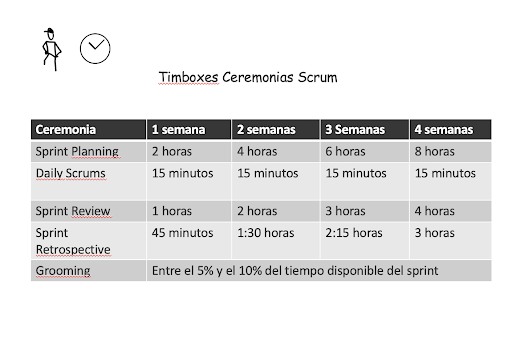
This chart reflects the different Scrum ceremonies and their weight, according to different weeks. Iterative development is realized in a sprint that contains the following Scrum events: Sprint Planning, Daily Meeting, Sprint Review, Sprint Retrospective, and Grooming.
Before diving deeper into the different events, it’s important to define what a Scrum sprint is. The sprint is the heart of this framework, the container of the other parts of the process. Everything that happens in an iteration to deliver value is within a sprint; the maximum length is one month and this duration is determined based on the level of communication that the client wants to have with the team. Long sprints can mean that valuable client feedback is lost and puts the project in danger.
In this meeting, the entire Scrum team will define what tasks they will undertake and the goal of the sprint. The first meeting of a sprint can be up to 8 hours for a one month sprint.
The team will ask the following questions:
The definition of what will be done gives the team a goal and makes them committed to the valuable deliverable that will be given to the client at the end of the sprint. This is called the Sprint Goal.
The result of the meeting is the Sprint Goal and a Sprint Backlog (which we’ll cover later on).
This is a daily meeting within the sprint that lasts a maximum of 15 minutes. The development team and the Scrum Master must attend this meeting no matter what; the Product Owner doesn’t need to be present.
In this daily meeting, the development team will ask the following three questions:
A Daily Scrum is the best place to be able to inspect completed work and adapt in case the sprint tasks have changed.
The value review that we will deliver to the client will happen in this meeting, which takes place at the end of each sprint. For one month sprints, it will last four hours and is the only Scrum meeting that the client may attend.
In this meeting, the Product Owner presents developments to the client and the team presents its work. The client validates the realized changes and, in addition, provides feedback about new tasks that the Product Owner will have to add to the Product Backlog.
The retrospective is the last Scrum event, lasts three hours for one month sprints, and is the team meeting in which the evaluation of the Scrum framework’s implementation in the latest sprint will be carried out.
It’s a great opportunity for the Scrum team to self-reflect, proposing improvements for the next sprint. The end result is a list of improvements to be applied the next day, given that once the retrospective is completed, the next sprint immediately starts, which includes the same events that were previously mentioned.
Scrum Grooming is the revision time dedicated within teams during sprints to touch-up its requirements. It’s a meeting that cannot occupy more than 10% of the sprint’s available time. The user’s tasks will be revised with a few advantage sprints so that once the team arrives, everything is ready for task development.
Scrum events and artifacts are defined to fully maximize transparency within the team; this means that everyone will have the same vision of what is happening in the project.
If you’re asking yourself what Scrum artifacts are, we’ll explain the 3 key aspects: Product Backlog, Sprint Backlog, and Increment.
Product Backlog is basically a list of tasks that captures an entire project. Anything that we have to do must be in the Product Backlog with an estimated time for the development team.
The responsibility of organizing the Product Backlog lies exclusively with the Product Owner, which is why they must be in contact communication with the client to ensure that priorities are properly established and the highest tasks are of a greater priority. The development team chooses tasks from the Product Backlog in the Sprint Planning to create both the Sprint Backlog and the Sprint Goal.
This is the group of tasks from the Product Backlog that the development team chooses in Sprint Planning together with their development plan. It must be known by the whole team, to ensure that the focus should be on that task group.
Sprint Planning doesn’t change during the sprint; only the plan can be changed to be able to develop them.
The Product Increment or Scrum Increment is the result of combining all the elements of the Product Backlog that were completed during the actual sprint and also adding the value of all previous sprints.
The sum of the increments are presented in each Sprint Review and various Scrum increments can be created within the same sprint.
Once we know how Scrum works, we can talk about its advantages and disadvantages:
To sum it up, the Scrum methodology is especially useful when working in highly uncertain environments, in those when the probability is high that there are changes in the program. If these requirements aren’t clear and if the client needs to quickly release a product in the market or needs an MVP, Scrum is the perfect framework. This framework allows us to deliver a product in various working and independent parts at a quick pace and with the ability to correct errors in the moment.
At We Are Marketing, various members of our development team are certified as Scrum Masters. We possess the knowledge and necessary tools to successfully complete projects using this framework and we offer clients visibility and control over our actions. Scrum embraces change; if you’re looking for an agile team that clearly understands this, you can trust We Are Marketing.