

Did you know that according to the Project Management Management Institute, high-performance organizations complete 80% of their projects on time in a way that meets the goals and budget established? If you want to start applying project management techniques and tools that help your company achieve success, read on.
Project management consists of applying a systematic focus on planning and guiding a project’s processes from the beginning to the end. According to the Project Management Institute (PMI), the secret to high-performance organizations’ efficacy stems from developing strategies, techniques, and teams built on sound project management practices.
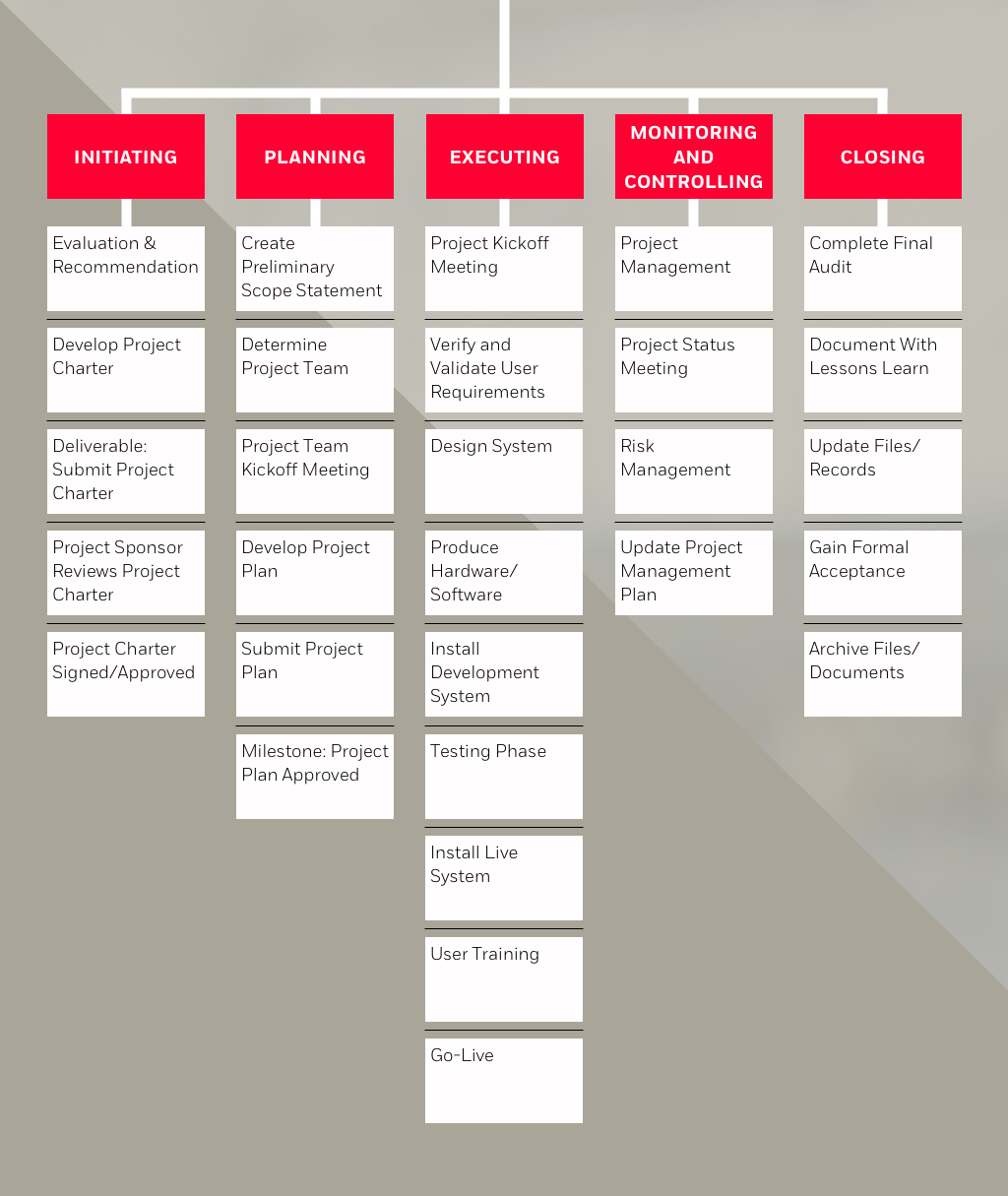
The PMI notes that these processes should fall under one of the following five stages:
However, various project management frameworks indicate different guidelines. An example is the Agile Methodology that allows you to rectify and change priorities when needed — projects operating under the Agile Methodology work using shorter time frames called sprints. Every sprint has a set of objectives, and the team has to meet them before the end of the sprint. This structure allows the project to progress bit by bit and allows for a more flexible structure when it comes to adding or getting rid of tasks.
This work holds great responsibility, and the person in the project manager role needs to be able to anticipate change, solve unexpected problems, and grab the client’s attention. A business’s success or failure, to a certain degree, lies in their hands.
That’s why a project management certification is becoming a more frequent requirement to ensure that someone has the necessary project management skills and knowledge to carry out this task.
Various studies indicate that those organizations with project management specialists experience a significant improvement in project development and an increased success rate.
The most tangible benefits are the following:
In sum, the lack of organizational activity considerably diminishes projects and strategic initiatives’ success.
While much will depend on the project management system you want to apply, there are some underlying fundamentals. Universia highlights the following:
These five aspects make up the foundation, but every project manager also needs to apply these six best practices:
The first step is to define the objectives we’re looking to achieve with the project, which is critical for making a real, efficient plan. Ask yourself this question: what do I want to achieve? Is it to put on an event for 1,000 people, expand the company abroad, improve your digital reputation?
The scope defines the project’s limits and serves as the basis for identifying the tasks in or outside the range as well as the amount of work to complete.
You must define these goals with the client since they should play an active role in the project rather than a spectator.
This result of this task in the Project Management discipline is called a Work Breakdown Structure. It’s about putting together a breakdown of all the tasks that are part of a project and turn them into smaller deliverables and represent them in a tree format. In this example in an Excel format, we can see the larger tasks 1 and 2 in blue representing the most critical deliverables and the smaller tasks that are part of the larger jobs consisting of the sub-deliverables. This structure repeats itself for all the components.
Here is a sample Work Breakdown Structure for one of our clients:
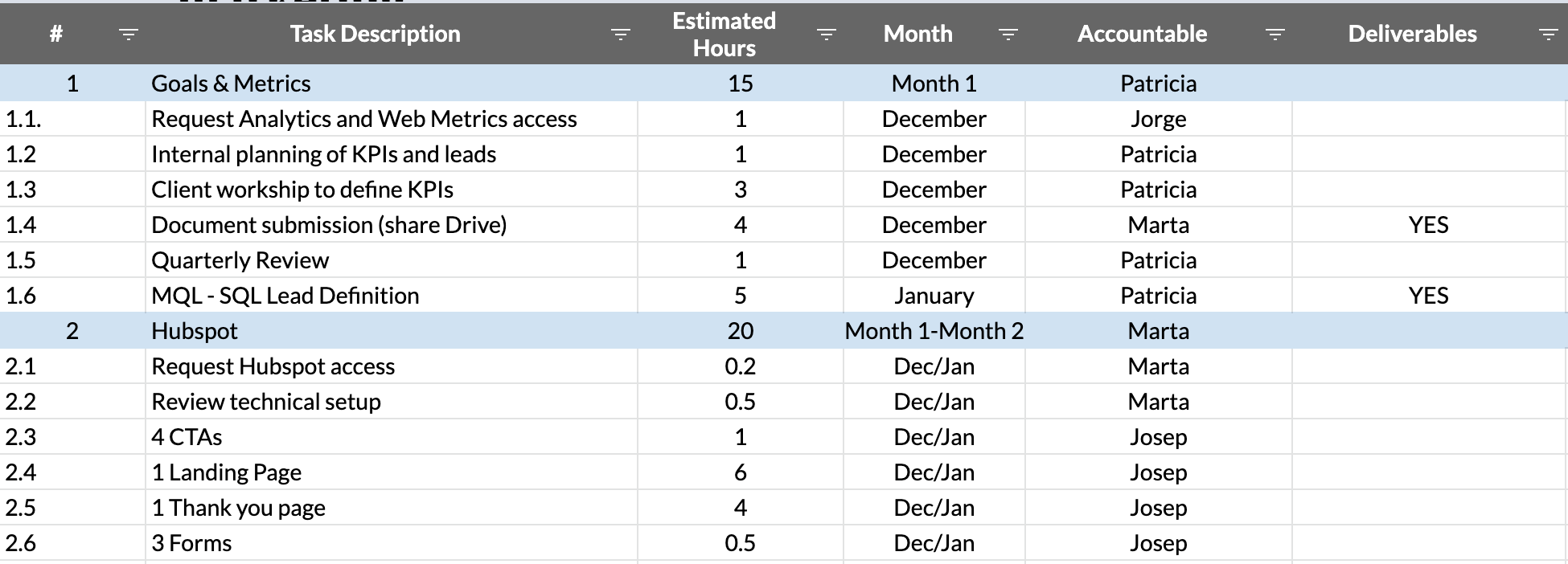 This project management tool is crucial, and its goal is to organize every project’s total scope in a structured format. The hierarchical form allows us to quickly and intuitively identify every work package. Every work package must have detailed documentation, so everyone involved in each task can efficiently and accurately complete it.
The project manager has to decide who will be in charge of every job in the Work Breakdown Structure and what resources are at their disposal to do so. It’s all about setting realistic goals that adjust to the team’s skills.
In the Agile Methodology, every task has one person who’s in charge of keeping everyone else accountable at the end of every sprint. This method empowers autonomy within the way the team works.
The timing or project calendar is fundamental for planning its development. Every process needs a start date and end date.
Establish timeframes while taking the project team’s opinion into account. They’re the specialists that will best know how much time they need to complete every task.
Consider possible factors that alter this planning, such as critical dates that could come up during the project and include them in your preparation to ensure your timeframes are flexible.
Be thorough while creating this document as it will let you:
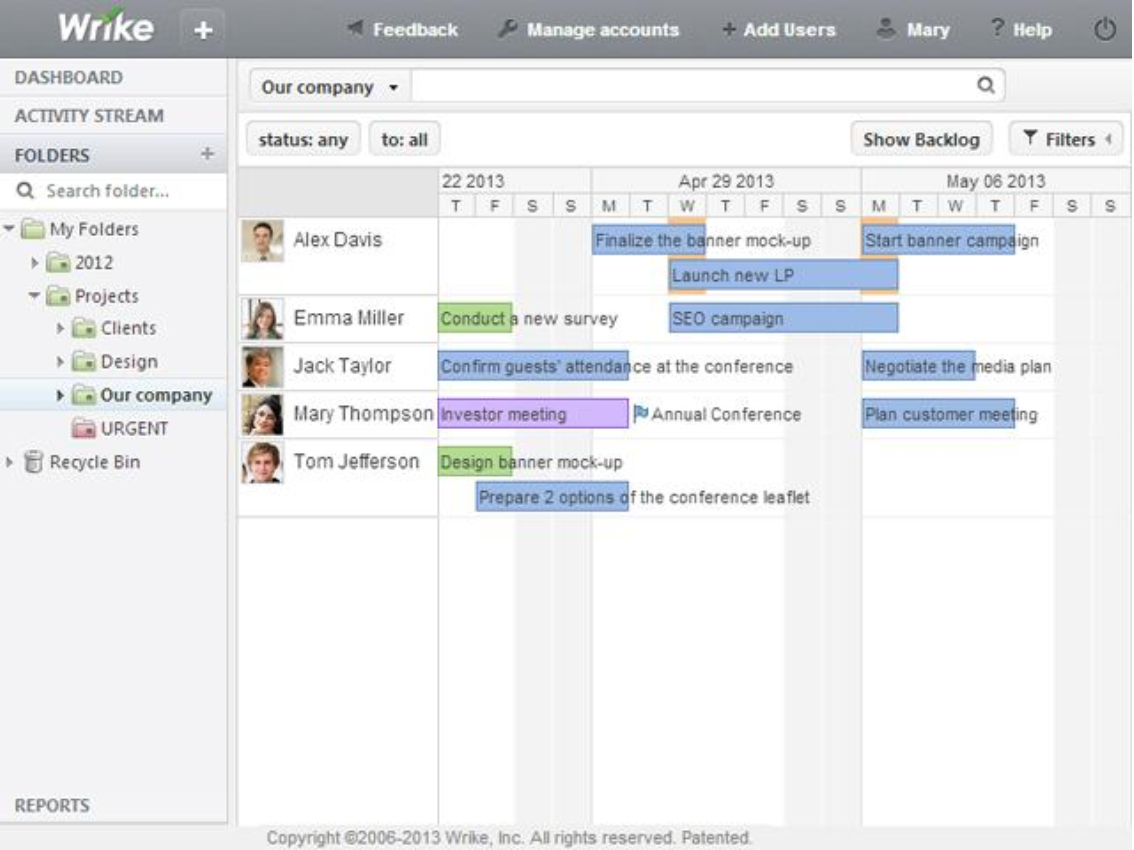
Once you establish the project timeframe, it’s a good idea the client reviews it so they are aware of when they’ll receive the deliverables. You can always use project management software that lets them see the status of every task in real-time.
Remember: a timeframe’s goal is to facilitate the communication between the client and the team working on the project. Therefore, you must forge a close relationship where the client gets to know the professionals working on carrying out the project.
You must keep an eye on costs to ensure you complete the work within the designated budget. You must watch both the internal production costs as well as external costs.
Project management tools tend to have an area where you can log the hours every team spends and helps keep internal costs at bay.
You should track them on a daily, but you also need to produce weekly reports to avoid discrepancies as well as make decisions and act before the costs exceed earnings.
The person in charge of the project must run periodic analyses and submit internal reports. They allow them to check and monitor the project’s status, as well as compare the actual progress with the projections in terms of the completion (or not) of timeframes as well as in costs, scope, and more.
This way, if needed, the director or manager can make changes that help improve the project’s efficiency in the present and future. Efficient change management can be the difference between a successful project or a failure.
Plus, once the work wraps up, you must carry out an internal retrospective to detect room for improvement for future projects. This meeting allows us to derive a series of learnings from every project.
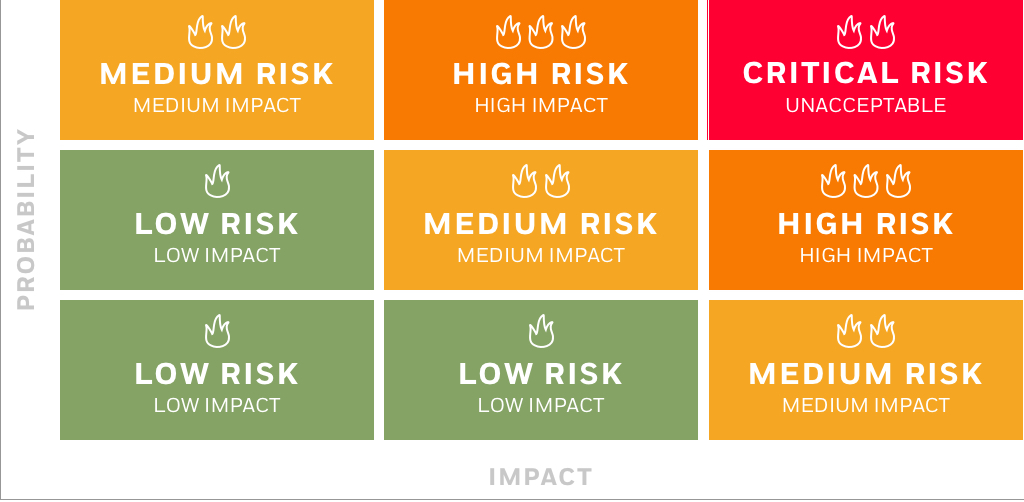
Every project has different risks that we need to identify sooner rather than later. We want to do this to avoid them turning into real-life obstacles when it’s time to carry out our project.
Knowledge Train recommended some measurements to calculate risk management:
Multiplying both these numbers let us find out the risk percentage: a high-risk factor indicates a problematic situation when it comes to completing the project. Therefore, continually reviewing risks will allow you to avoid possible failure.
If we manage to foster a culture around project management, organizations will enjoy a considerable competitive advantage. There are plenty of collaborative and non-collaborative tools out there that help us optimize our project management. The most important thing is to have someone with experience in leading and projects and to apply best practices in their day-to-day job.