


The customer journey represents the phases a customer archetype passes through as they interact with the product or service under analysis. We have to distinguish the stages the Buyer Persona goes through, mapping out the experience a customer has before, during, and after being in contact with our product or service, usage context, motivations, goals, and even finding out how they’re feeling at all times.
Prospective consumers won’t seek out brands unless they need them. That’s when they’ll start researching the different options out there on the market and what can best satisfy their needs. Then, they’ll choose the product or service, and if all goes well, they’ll buy it. This complete customer life cycle is when we make our brand premise tangible. We’ll gain customers’ loyalty if it works for them. If we do it well, we’ll gain fans and recommendations.

The customer journey represents the phases a customer archetype passes through as they interact with the product or service under analysis. We have to distinguish the stages the Buyer Persona goes through, mapping out the experience a customer has before, during, and after being in contact with our product or service, usage context, motivations, goals, and even finding out how they’re feeling at all times.
Prospective consumers won’t seek out brands unless they need them. That’s when they’ll start researching the different options out there on the market and what can best satisfy their needs. Then, they’ll choose the product or service, and if all goes well, they’ll buy it. This complete customer life cycle is when we make our brand premise tangible. We’ll gain customers’ loyalty if it works for them. If we do it well, we’ll gain fans and recommendations.
Touchpoints in marketing are the channels a firm or customer can interact with each other. The examples of touchpoints in marketing can include brick-and-mortar stores, the Customer Service department, website, social media, calls-to-action (CTAs), etc. The result can be very straightforward or complicated as we need it to understand our customers and provide them value.
Our end-goal is that we want the information in the customer journey map for every Buyer Persona to help us in several ways. They’re what we offer, pinpoint potential mistakes or discrepancies in what we want to provide and what we provide in real life, or even find the best channel for communicating with our customers. Every interaction can create an experience and works towards fostering a relationship between brands and customers.
The sum of all these touchpoints and experiences work towards creating sentiment about the product or service and consumers’ attitudes and behaviours towards the brand. Touchpoints are some of the critical components of Customer Experience Management (CXM) since that’s the place where we foster the bond (experience) between the brand and the customer. Touchpoints go into a broader concept of the customer business life cycle where brands get hooked.
There are many moments that matter throughout the customer life cycle and they expect we’ll give them good experiences throughout the entire cycle. If we fail in something critical and don’t know how to figure it out, the customer will abandon us.
It’s essential to consider three elements of the current market panorama and consumer behaviour when working on our customer life cycle marketing. They are:
Due to these three fundamental factors in today’s consumer behaviour, marketing with micro-moments has proven critical for defining customer touchpoints. This Google ad perfectly summarizes why it has so much prominence now.
Access to information grants consumers the ability to evaluate options throughout the entire customer life cycle continuously. Search and analysis are intentional and sway decisions, whether they’re the moment and time. The relevance and quality of the information in those micro-moments modulates the purchase decision.
Every organization must define the touchpoint map that best adapts to their customers and context. Before we can correctly set these touchpoints, we must:
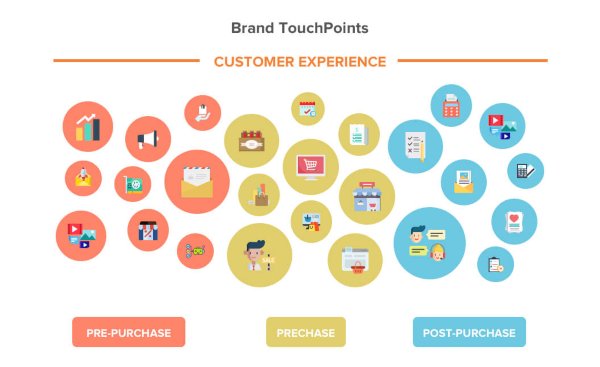 Source: Net Solutions
The customer’s vision is different from that of the brand, so we can’t base ourselves merely on internal analyses or reproduce touchpoint maps that reflect our organizational structure.
Not all customers follow the same path in their relationship with us, nor do they have the same needs. That’s why we must understand the key differences between types of customers and distinguishing between touchpoints. How can we do it? We must identify and ensure the emotional components of our customers are in the touchpoint map. Our discussions of measuring and being objective also encompass the customer’s world of emotions.
We must also know what our competitors are doing and how we can stand out. We must also anticipate whether what we’re proposing is something our competitors can easily emulate. We must make adjustments over time as our definition of touchpoints, and the touchpoint map will differ depending on what our customers do, our business, and other factors that can impact them both.
We must have our touchpoints in mind with a goal of garnering customer loyalty, or once they’ve bought our product or contracted our service.
The most effective representation of the touchpoint map is on a Cartesian axis. We represent the moments of our customer’s life cycle on one axis and the potential channels where they contact our brand on the other.
We can find different elements that serve as content on our touchpoint map:
The balance and homogeneity that we’re going to deliver in the various touchpoints are critical. We know that customers integrate experiences to form an opinion. These opinions are not static over time, as well as in every purchasing stage.
We must have our touchpoints in mind to garner customer loyalty, or once they’ve bought our product or contracted our service.
The value proposition we create and end up transmitting is the reflection of our business strategy. We must decide what variables will be part of it:
The touchpoint map is a vital component for managing our Customer Experience Management strategy. It will be our primary means of communication to the organization and where we’ll define our goals and metrics. We must design the Customer Experience and not leave it to chance by creating a touchpoint map.
We build this map on top of the customer journey stage in their relationship with the brand and our strategy. It must have coherence to be practical. The key lies in having a concrete value proposition.
Measuring and correlating our metrics with crucial business indicators helps complete these interactions and get the best out of each touchpoint.