
Most visitors that come to a website for a product or service for the first time aren’t ready to make a purchase. We, as users, have built out a rationale that helps our purchase decision-making more straightforward. That’s what we call the buyer journey or customer journey. This process starts with pinpointing the problem a product or service will solve and goes until we decide what product or service we’re going to acquire.
Understanding what actions customers complete before or after purchasing is a significant advantage for your enterprise within a 360° Marketing strategy. It aids in increasing your ability to acquire more customers. It also helps us boost our ability to feed them through the potential customer process through Lead Nurturing. This information is also useful for evaluating your Customer Lifetime Value, for example.
We’ll go into further detail into what is the Buyer Journey, what are the stages of the buyer’s journey, and how to put it into practice using an example.
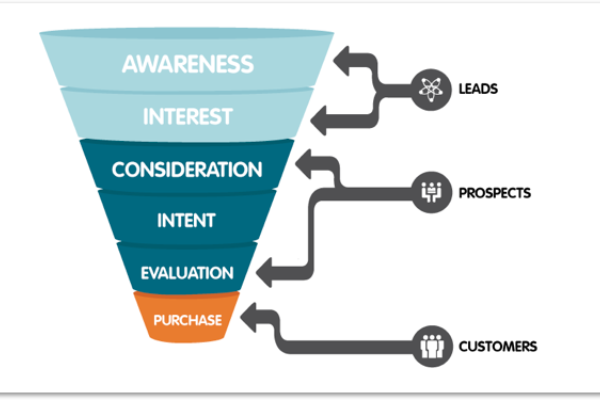 Source: Sleek Note
The Buyer Journey is the active search process of a prospect before making a purchase. It’s one of the fundamental tools of an Inbound Marketing strategy (that tends to include Permission Marketing) that you must define along with your enterprise’s Buyer Persona.
The user passes through a series of well-defined steps in the purchasing cycle: discovery, consideration, and decision.
Let’s look at a sample Buyer Persona and the journey they go through to understand better how the process occurs:
As I previously noted, the firms that know and work on each of the Buyer Journey stages will have a significant advantage over their competitors. If you’re wondering how to create a buyer journey map, you need to know that one of the goals is to offer them compelling, informational, useful content during every stage to guide them through the decision-making process naturally.

Knowing what content to produce in every stage is critical for successful Lead Nurturing. How do you go about defining and tracing this content effectively through the Buyer Journey? Follow these steps:
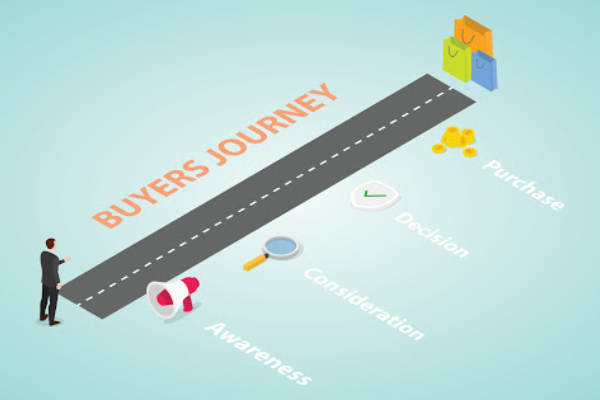
What are the different content types and formats that fit in every moment of the process? They are:
How would we set up the Buyer Journey for our fictionalized Javier, the dental clinic owner looking for an online accessory and shoe store? Here’s how we would do it:
From the beginning of his customer journey, Javier thinks about how he can’t wear the clothes he likes at work and doesn’t have time to go shopping. He decides to go online and research quality shoes he can wear during his free time in fashion magazines and blogs.
In the Buyer Journey discovery stage and when he starts to research, we have to concern ourselves with boosting our rankings on Google. We achieve it by carrying out keyword research to determine what we want to bid on with Paid Media or position ourselves organically so that when Javier is Googling for our product, we’re as close to the top of the results as possible. Showing up at the top of the results page is vital, whether in organic search results or with Paid Media, while including a curated image and transmitting critical information to click on the URL of our website. From a content perspective, we can create our blog with articles that detail our footwear catalog and attributes.
Javier is now in the conversion stage. He’s been on a bunch of websites and compared prices, models, shipping methods, and the other perks stemming from the various e-commerce sites. What do we need to attract and sway him towards us? We have to look for dynamic formats: short social media videos with tips, graphics, and downloadable dossiers with a significant amount of curated images concerning our products.
Another fundamental piece of the puzzle in this part of the purchasing cycling is remarketing tactics on the web and social media. That means that once Javier goes on the e-commerce site, he’ll get served related ads from the brand to foster brand awareness and place it in the consumer’s top-of-mind.
In this sense, social media platforms are critical conduits in the consideration phase. That’s why we have to curate them to ensure Javier sees other shoe images, discovers the latest items, etc. All this information will provide him with more details and value.
We finally convinced Javier, and he starts going through the purchasing process to buy his shoes on our e-commerce site. We have to ensure the best buying process possible, making a webpage with optimal UX vital. We also have to implement details such as confirmation emails, shipping, and a reliable payment gateway to make Javier loyal to us. We must ensure that everything goes off without a hitch to ensure our customer’s satisfaction.
It’s also useful to offer a direct line of communication with the brand in case of any incident and offer any necessary and additional documentation about the product he just bought so he can learn more about it. It can be through live chat or a dedicated customer service phone line. Sample content can be information about where you manufacture the shoes and the materials in the shoes, among others.
You now have everything you need to set up one of the most crucial pieces of your Inbound Marketing strategy. Remember that the Buyer Journey and Marketing go hand-in-hand. If we don’t know how your ideal customer behaves and makes decisions, you won’t be able to offer them the best solutions.